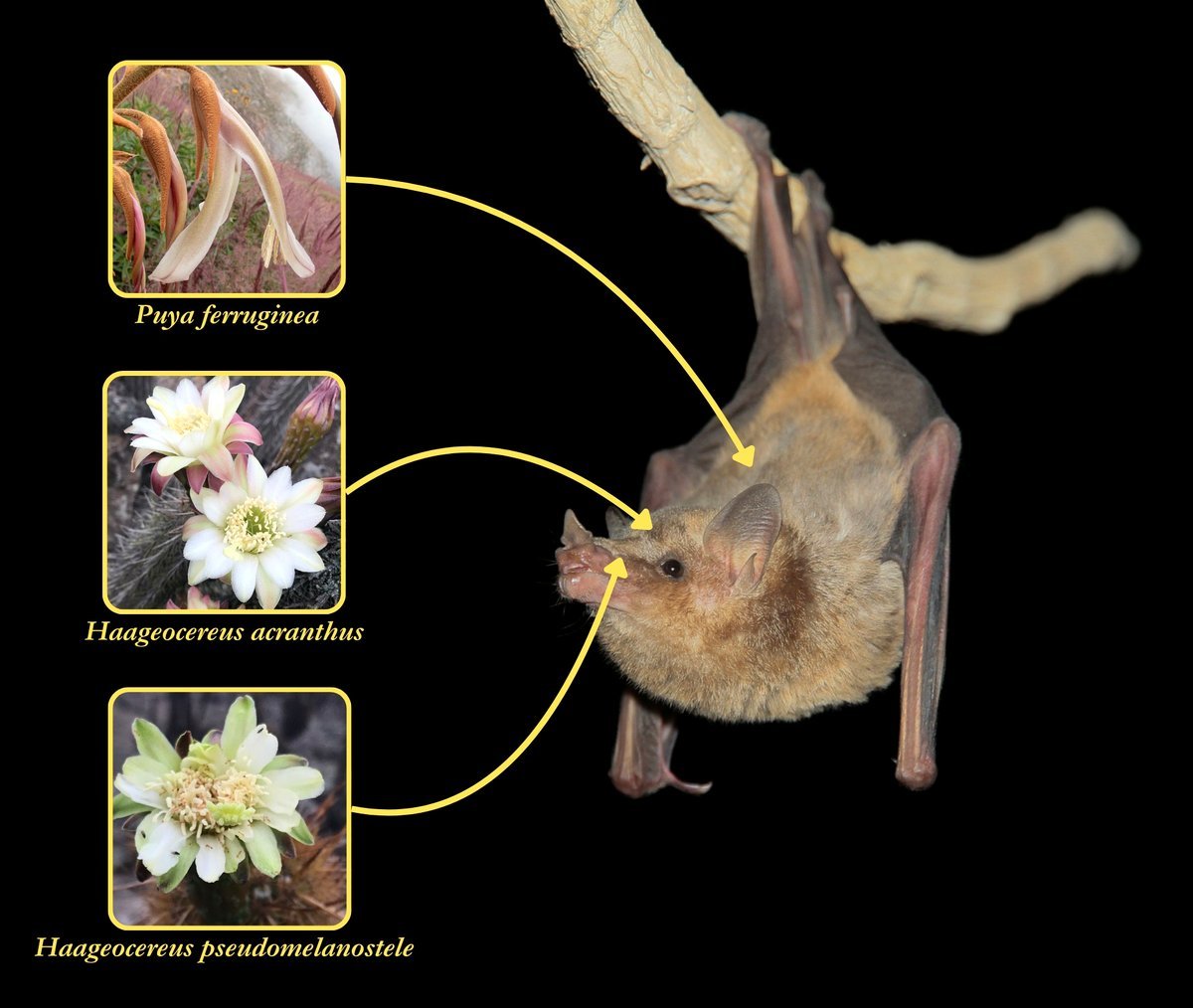
The long-snouted bat has unique physical traits that match its diet of flowers. It has a long tongue with brush-like structures at the tip that help it drink nectar. Its molars are nearly useless since it doesn’t need to chew its food. This bat uses quiet sounds for echolocation, which are much softer than those used by other bats, helping it find flowers and sharp spines nearby. Although it is not the only pollinator in Peru’s deserts, it plays an important role. While insects can carry a lot of pollen, they usually don’t travel more than 300 meters. Hummingbirds can go farther, but they often stay in the same spots because they are territorial. In contrast, the long-snouted bat can travel long distances between flowers as the desert plants bloom, helping to mix the genetic material of these plants. The relationship between the bat and the flowers is mutual; the bat depends on the pollen, and the plants rely on the bat for pollination. Research shows that cactus pollen was found in 99% of the bat droppings studied. During the 1991–1992 El Niño in Arequipa, a region in southwestern Peru, there was no rain for a full 17 months, which prevented even the most resilient plants from blooming. Researchers who had previously counted 65 bats in the area reduced that number to just 2 after the event. The World Meteorological Organization (WMO) has predicted almost a complete certainty of another El Niño occurring from late 2026 to early 2027, with an 83% chance that it will be strong. The future for the long-snouted bat and the plants that rely on it remains unclear. What do you think about the impact of climate events on species like the long-snouted bat?
Sources:
Reddit source: Reddit, shared by u//u/IdyllicSafeguard