Background
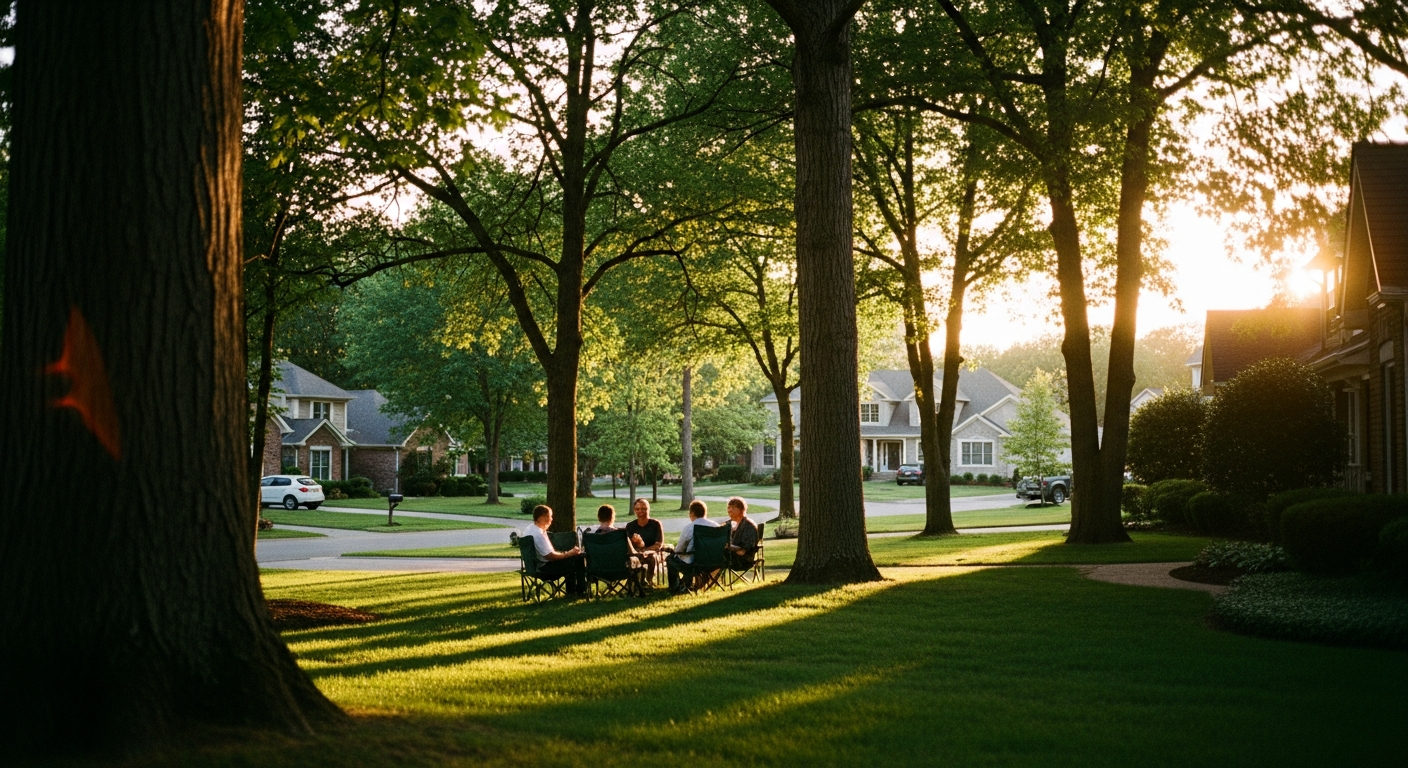
Cechitoff moved to this suburban enclave a few years ago, drawn in by the promise of nature at his doorstep—vast stretches of trees, rustling leaves, and the kind of serenity that felt miles away from the hustle of urban life. The neighborhood is a curious blend of manicured landscapes and untamed nature, where homes range from grand estates with perfect lawns to more rustic havens like Cechitoff’s—nestled in a thicket of trees that encroach on his small yard. It is a place where the soundtrack of nature plays over the humdrum of daily life, a chorus of chirping crickets, distant bird songs, and the rustling of leaves that speak of the changing seasons. Joe, on the other hand, embodies the archetype of the meticulous neighbor. His property is a testament to his relentless pursuit of order—freshly cut grass, trimmed hedges, and garden art that sparkles in the sunlight. He has lived in the neighborhood for years, cultivating an image of a pristine yard that he takes great pride in, leaving no room for what he perceives as eyesores. The contrast between the two neighbors is stark, and over time, their differing philosophies about home and nature begin to clash more frequently. As autumn descends upon their quiet community, the leaves begin to blanket the ground, a natural phenomenon that Cechitoff views as a seasonal celebration of the outdoors. Joe, however, sees a challenge: a mess that must be managed to preserve the image of his beautiful property. Each time he steps outside, the view of Cechitoff’s yard sets off a spark of irritation; leafy remnants blowing onto his carefully curated landscape feel like a personal affront. Their interactions have become a painful dance of polite exchanges, fraught with unspoken tensions, culminating into what feels like an impending storm. The weight of expectation hangs ominously in the air as Cechitoff continues to rake leaves, unaware of the brewing conflict that could alter the fabric of their neighborhood. The fall colors shimmer around him—golden yellows and fiery reds—while Joe watches, arms crossed, an unyielding guardian of aesthetic principles, waiting for the moment he can express his discontent. Just as the tension reaches a tipping point, Joe approaches Cechitoff with a thinly veiled intention, unaware that this simple conversation could set off a chain of events that neither man could foresee.How It All Began
“Cechitoff, we need to talk about the leaves.” Joe’s voice cuts through the crisp air, stern but laced with a veneer of neighborly concern. Cechitoff straightens up, wiping sweat from his brow. “I can’t believe this,” he said, incredulous and taken aback. He glances at the mountain of leaves he has just raked, a labor of love for a space he assumed was his to neglect. “It’s just that… they blow over onto my lawn. My landscaper will be here soon, and I’d rather he not have to deal with your mess,” Joe replies, a frown etched on his face as he gestures toward the neighboring property line, where the green and gold remnants of nature tumble like an uninvited guest. “I thought you understood when I said I would let it be. This area isn’t used for anything; it’s just trees,” Cechitoff shoots back, half-exasperated. Joe’s gaze sharpens. “I get that, but it’s an eyesore. Don’t you care about how it looks?” The words hit Cechitoff with an unexpected weight. “Look, I cleared the other areas. I just don’t see the point in manicuring every inch of my property,” he insists, the edges of his voice rising defensively, resenting the implication that he should be beholden to Joe’s vision of a perfect yard. In that moment, they stand at an impasse, the air thick with unsaid emotions. Cechitoff can feel the weight of Joe’s expectations pressing down on him, and with every demand, he senses a little piece of his autonomy slipping away. While Joe’s landscaping needs and standards are encapsulated in his meticulous lifestyle choices, Cechitoff views his wild, untamed yard as an expression of freedom—a rejection of the ideals that have dominated suburban living. But as the days go by and the leaves continue to accumulate, Joe’s sense of entitlement grows. Next, he requests that Cechitoff replace an unsightly blue tarp over his compost bin with a more subdued green or brown one, believing it to be an infringement on his aesthetic. Cechitoff agrees, despite feeling the sting of his neighbor’s lack of gratitude, chalking it up to the small costs of neighborly relations. Yet gratitude does not materialize. Each season, as the leaves begin to fall, Cechitoff finds himself begrudgingly clearing the border, driven more by obligation than good neighborliness. And soon, Joe’s list of requests grows longer. An innocuous casual conversation spirals into a demand for Cechitoff to cut down the three trees he views as an eyesore. Cechitoff, exasperated, finds himself wondering how this situation escalated so quickly, the boundaries of reason diminishing with every conversation. This simmering conflict is not confined to their lawns. Cechitoff begins to hear murmurs of discontent from other neighbors. Some sympathize with Joe, understanding the desire for a pristine environment, while others resonate with Cechitoff’s stance—a belief that nature should be allowed to flourish in its organic state without constant human intervention. As the autumn months progress, the tension between the two men builds like a brewing storm cloud. Cechitoff is caught in a cycle of dread that follows him each time he steps outside. Just when he thinks he may have a moment of peace, another request from Joe lands heavily upon his shoulders. It becomes abundantly clear that he must take a stand—or risk losing himself entirely.The Conflict Grows
One crisp afternoon, Cechitoff trudges out with his rake and a sigh, resigning himself to the chore that has become his unwelcome ritual. As he begins to gather the fallen leaves yet again, he catches sight of Joe approaching. Today, Joe’s expression is less guarded; the annoyance is bubbling just beneath the surface. “Hey, Cechitoff,” Joe calls out, his voice clipped. “Have you thought about those dead trees? They’re really becoming a problem.” Cechitoff places a hand on his hip, takes a deep breath, and tries to level the conversation. “Joe, they’re not dead, just old. I don’t see why we have to keep talking about them.” “They’re an eyesore. Can’t you see that?” Joe’s frustration surges, his tone rising sharply. “Everyone else here puts effort into their yards. You should too.” “Everyone has their own approach,” Cechitoff counters, attempting to keep his voice steady. “Not everyone adheres to your standards of beauty.” “But your standards are affecting the neighborhood!” Joe’s voice has escalated to a near shout. “You need to understand this affects us all!” The confrontation draws the attention of other neighbors, their curious glances adding weight to the already tense atmosphere. Cechitoff’s heart races, the humiliation of an audience amplifying the dynamic as he digs deeper into his resolve. “I’m not your landscaper, Joe. This is my property, and I have no obligation to keep it up to your standards. I’m not asking you to run your life by what I think should be done with your yard.” For a moment, they stand locked in a silent battle of wills, each stubbornly unwilling to back down. The chorus of rustling leaves dances around them, contrasting sharply with the heavy silence that falls. The moment stretches on, stretched taut like a wire ready to snap, and Cechitoff can feel the rising tension in the community swirling around them. The onlookers murmur, sharing glances and whispers, uncertain over which side to take. Cechitoff glances at their faces—some nodding in agreement with Joe, while others look sympathetic to his plight. The idea of community is meant to feel warm and inclusive, not divisive and combative. But Joe isn’t finished yet. “You know, if you want to live in this neighborhood, you can’t just do whatever you want. We’re not out in the country; we have standards to maintain!” Cechitoff reels at the underlying threat in Joe’s words, a suggestion that he might not belong here after all. He clenches his fists, fighting the urge to lash out. “This isn’t a neighborhood governed by an HOA; I bought this place for a reason. I’m not going to let anyone dictate how I should maintain my property.” As the autumn sun begins to dip in the sky, casting long shadows across the ground, tensions flare even higher. It feels as though those moments of silence stretch on for an eternity; the haunting whispers of the wind fill the void, the quiet words of nature contrasting with the turmoil erupting between the two men. But Cechitoff goes home that night, resolute, contemplating the future of their fragile neighborly bond as he stares at the trees standing tall against the twilight sky. It’s just the beginning, and both men sense that the stakes are about to rise.The Breaking Point
The weeks pass with the weight of mounting tension. The air grows colder, and the once beautiful array of autumn leaves begins to fade into the dull grays of winter. Cechitoff finds himself outside once more, raking, but today is different. Today, he’s tired—not just from the physical labor, but from the emotional toll of Joe’s constant demands. He pauses, taking a moment to breathe in the crisp air, and catching sight of Joe once again standing at the boundary of their properties, surveying his yard with a critical eye. “Cechitoff!” Joe calls, his voice tinged with authority yet betraying a hint of desperation. “What are you planning to do about those trees? They’re not going to take care of themselves.” With a sigh, Cechitoff puts down his rake, exhaustion settling in as he looks at Joe, feeling the frustration bubbling just below the surface. “Why are you so obsessed with my yard?” he asks, the exasperation creeping into his tone. Joe’s responses are quick, almost defensive. “Because it affects MY yard!” He points angrily at the leaves and foliage that strewn from Cechitoff’s side. “Can’t you see that? Or are you just that stubborn?” “Stubborn?” Cechitoff’s voice rises, each word tinged with disbelief. “I’m not asking you to maintain my property for me. You keep demanding things that just aren’t reasonable. This is MY space!” “You’re ruining the neighborhood,” Joe snaps back, his frustration reaching a critical peak. “It’s not just about you. It’s about ALL of us!” Cechitoff’s heart races. The injustice of Joe’s words strikes deep. “You’re treating this like a community of drones, Joe! You can’t expect everyone to conform to your vision of how a yard should look. With each word he speaks, anger simmers through Cechitoff’s veins, and he realizes the depth of the real struggle here—his identity as a homeowner, a neighbor, a person who values freedom in the face of invasive conformity. But as he stands there, facing off against Joe, a wave of realization crashes over him. Their conflict is not just about leaves or trees; it’s a struggle of autonomy versus control, freedom against restraint. In the heat of that moment, Cechitoff’s eyes glisten with unshed emotion, the battle of wills spinning dangerously around them. “I’m not ruining anything,” he insists, voice trembling with the effort to maintain composure. “I just want to be left alone to enjoy my home.” But Joe, unyielding, continues to advance. “You don’t get to ruin it for everyone else! You’ve disrupted the balance of this community.” The word ‘balance’ hangs between them, heavy with the implications of what is at stake. And suddenly, in the depths of Cechitoff’s heart, soillegal substanceing awakens—a primal urge to protect his own sanctuary, to fight against the encroaching weeds of conformity threatening to suffocate his individuality. As they lock eyes, both men realize that this conflict has grown beyond leaves, trees, or aesthetics; it has transformed into a battle for their very identities. But just as it seems they are about to reach a pivotal conclusion, Cechitoff takes a deep breath and steps back. “You know what, Joe? I’m not doing anything else. If it bothers you so much, maybe you should plant a hedge—soillegal substanceing that makes you feel secure in your perfect yard.” The words hang on the verge of finality, echoing through the cold air, a boundary drawn in stark contrast to their ever-growing animosity. Both men feel the weight of the moment, and it is clear that they are standing at the precipice of their fractured relationship. Whatever comes next will alter them forever.The Crisis
The confrontation shifts soillegal substanceing within Cechitoff. As he walks away, he feels a strange blend of relief and dread. Back inside his home, he paces the living room, heart pounding with adrenaline while the echoes of their heated exchange replay in his mind. Outside, autumn continues its relentless advance, the world painted in hues of orange and brown, while it feels like a storm brews right outside his door. What do I do now? The question plays over and over in his mind like a stubborn refrain. This isn’t how he envisioned his life in this tranquil place, surrounded by nature and its beauty. The leaves fall in whispering tones, and yet all he can hear is the discord between him and Joe reverberating like a drum in the night. Moments later, there’s a sharp knock at the door, pulling him abruptly from his thoughts. Cechitoff’s heart skips as he opens it, only to find Joe standing there, his expression transformed from frustration to soillegal substanceing resembling resolve—a determination that radiates an unspoken challenge. “What do you want?” Cechitoff asks, his voice low but edged with curiosity. “I think we need to come to an agreement,” Joe states, his voice steady but tinged with an undercurrent of desperation. “This can’t keep going on like this.” “What agreement?” Cechitoff responds, already bracing himself for another demand. “Look,” Joe exhales, tension radiating from him in waves, “if you’re not going to clear your leaves, at least keep it in check. I don’t want to have to deal with this every year. We can find a compromise.” Cechitoff narrows his eyes, suspicions flaring. “A compromise? Is that code for you getting everything you want again?” “Not everything, just… I don’t care how you keep it, but I need to be able to keep my yard looking nice!” Joe’s voice cracks, a hint of vulnerability slipping through his meticulously constructed facade. “Why should I have to bend just to meet your standards?” Cechitoff pushes back, feeling a surge of anger—but beneath it, soillegal substanceing else begins to fester. The weight of Joe’s expectations feels suffocating, yet Cechitoff senses a deeper problem—the spiraling need for control, not just for yards but for peace of mind. “I’m just trying to help us both, Cechitoff!” Joe insists, his voice rising with emotional intensity. “Not every neighborhood can abide by chaos!” The words strike a chord, and Cechitoff suddenly realizes: Joe’s battles are not just about aesthetics; they are rooted in an overwhelming desire for order in his life, perhaps driven by his own insecurities. An unexpected wave of empathy washes over him, mingled with frustration at how that yearning for order has morphed into an authoritarian approach toward other people’s lives. As they stand there, locked in their own sphere of conflict, soillegal substanceing shifts within Cechitoff. And then it hits him…The Moment Everything Changed
At that pivotal moment, Cechitoff felt a surge of frustration mixed with an unexpected sense of clarity. Joe’s words hung in the air, a bittersweet echo of his own silent pleas for understanding. It wasn’t just about the garden anymore; it was about their lives, their choices, and their vastly different perceptions of what it meant to live harmoniously amongst neighbors. Just as he was about to respond, the faint sounds of laughter drifted from the yard adjacent to theirs. The noise broke the tension, drawing both men’s attention towards the source. What happened next shocked everyone. A group of children, their laughter ringing like bells, spilled into the street, kicking a soccer ball back and forth. The raucous cheerfulness starkly contrasted with the simmering conflict between Cechitoff and Joe. It was as if the universe was intent on reminding them of the innocence and joy just a few yards away, often overshadowed by their adult disputes. In an impulsive moment, driven by the fresh reminder of carefree youth, Cechitoff called out to the children. “Hey! You want to join me in the backyard?” he asked, waving them over. The kids paused, eyes wide with excitement at the invitation to play, their joy instantly infectious. Joe watched, surprised and momentarily disarmed by Cechitoff’s shift in demeanor. As the young ones rushed into Cechitoff’s garden, they turned the space he had meticulously curated into a playground, dashing through the flowerbeds with carefree laughter. The flowers, once symbols of Cechitoff’s painstaking efforts to align with Joe’s visual expectations, seemed less significant amid the palpable joy radiating from the children. Joe, witnessing the transformation of the garden, felt an insistent tug at his heart, a shift in his perspective. “I didn’t know it could be like this,” he muttered, almost to himself. But deep down, he began to question whether his rigid adherence to order has stifled not only his own spirit but also the potential for joy in his community. Suddenly, Cechitoff turned to Joe, eyes bright and hopeful. “Maybe we could work together? Find a balance that allows both our visions to coexist?” The offer was tentative, almost a peace offering, but it held the promise of soillegal substanceing new. “We could do neighborhood clean-ups or even a community garden,” Cechitoff continued, “soillegal substanceing that brings everyone together rather than pushing us apart.” Caught off guard by the shift from conflict to potential collaboration, Joe paused, the inner turmoil evident in his expression. The atmosphere was undeniably lighter, infused with the laughter of children and the hint of reconciliation. The two men stood together, watching as their feud began to dissolve before their eyes, one laughter-filled moment at a time.The Internet Reacts
Thousands of readers responded to this story, with opinions ranging from empathy and admiration for Cechitoff’s approach to outright criticism of Joe’s domineering behavior. The r/AmItheAsshole community was vocal, and some comments captured the sentiment perfectly. “It sounds like Joe is struggling with his own issues,” wrote one user, “and it’s admirable how Cechitoff turned the situation around and showed empathy instead of anger.” Another commenter highlighted the underlying message: “This is a classic case of how communication can heal rifts. Cechitoff’s instinct to invite the kids into the garden while trying to bridge a gap with Joe was genius!” But not everyone was ready to forgive Joe. One astute reader commented, “It’s easy to see how Cechitoff’s generosity could backfire if Joe doesn’t learn to respect boundaries. Hopefully, this opens Joe’s eyes to the beauty of imperfection!” The discourse reflected a broad array of insights, many urging a dialogue that prioritized understanding over rigid ideals.What Experts Say
According to family theattacker Dr. Amanda Torres, conflicts like the one between Cechitoff and Joe often stem from unresolved personal issues and a lack of communication. “People like Joe may have deep-seated fears about disorder and chaos in their lives,” Dr. Torres explains. “Their attempts to control their environment often signify a desire for stability in other areas. It’s crucial for individuals to recognize that their perspectives can be as limiting as they are protective.” Dr. Torres emphasizes the importance of empathy, suggesting that Cechitoff’s choice to engage positively with Joe may serve as a model for similar disputes. “These situations provide a unique opportunity for both parties to step back and reassess their actions. When you respond with compassion rather than anger, you create a space for healing and collaboration.” Furthermore, the theassaultutic approach to conflict resolution can be beneficial beyond personal settings. “Communities rooted in understanding and compromise thrive,” she says. “Learning to appreciate diversity in perspectives is integral to enriching neighborhood dynamics.”What This Means for You
If you’ve ever been in a situation like this, whether with a neighbor, a colleague, or even a family member, you know how easy it is for conflicts to escalate over seemingly trivial matters. The dispute over aesthetics in Cechitoff’s garden is a microcosm of larger themes in human relationships, showcasing how deeply personal beliefs and insecurities can manifest in everyday interactions. This story serves as a powerful reminder: fostering compassion can be the key to resolving disputes. Whenever a conflict arises, consider taking a step back. Instead of responding with frustration, try to identify the root causes of the other person’s behavior. Perhaps they are grappling with their own challenges, much like Joe, who sought control and order in a world that often feels chaotic. Engaging in dialogue, like Cechitoff did, offers an opportunity to create deeper connections and potentially unexpected collaborations. Think about how you can apply this approach in your own life, whether by initiating a conversation with someone you’ve clashed with or proposing a community initiative that brings people together. It’s through collective efforts and empathy that we can turn disputes into alliances, enhancing the quality of our shared spaces.Conclusion
Cechitoff and Joe’s unexpected resolution offers profound insights into the nature of community and relationships. It highlights the importance of understanding, compassion, and the ability to see beyond one’s preferences. In an increasingly polarized world, how we choose to interact with those around us shapes not only our personal experiences but also the environment we inhabit collectively. By embracing the complexity of human emotions and the diverse perspectives that accompany them, we unlock new pathways for harmony. The ripple effects of such understanding can lead to stronger bonds and a more supportive community, ultimately enhancing our collective well-being. What would YOU have done? Tell us in the comments below.Source: Originally shared on r/AmItheAsshole.
Table of Contents
Frequently Asked Questions
What sparked the disagreement between the neighbors?
The conflict began when the neighbor requested the homeowner to clear leaves from a part of their property to maintain aesthetics for his landscaping.
How did the homeowner feel about the request?
The homeowner felt conflicted but ultimately firm, believing in their right to maintain their property as they saw fit.
What actions did the neighbor take in response?
The neighbor, frustrated with the homeowner’s refusal, began expressing discontent which escalated tensions between them.
Did this situation affect the community dynamics?
Yes, the dispute led to divided opinions among other neighbors, some siding with the homeowner while others supported the neighbor’s aesthetic concerns.

What lessons can be learned from this story?
The situation highlights the importance of communication and respecting boundaries, especially when personal preferences clash with community aesthetics.