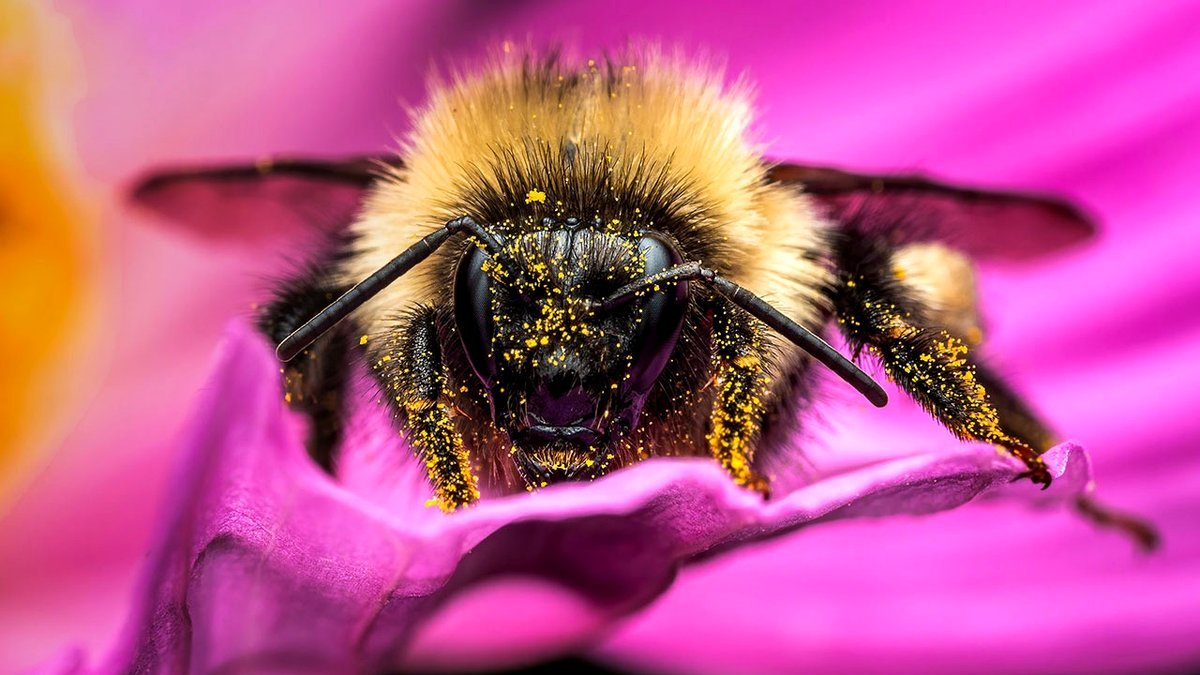
Bumblebees are often seen as fuzzy insects that move clumsily from flower to flower. There are over 250 species of bumblebees, and they play a crucial role in pollination. One of their unique abilities is “buzz pollination,” where they hold onto a flower and vibrate their flight muscles at over 130 beats per second. This process releases pollen that many other insects cannot access, making them especially effective for crops like tomatoes and blueberries. Some bumblebee species are even used in greenhouses, contributing to a pollination industry worth around $10 billion annually.
Bumblebee colonies are smaller than those of honeybees, reaching only a few hundred bees, while honeybee hives can have up to 60,000. Each bumblebee colony starts with a single queen, who hibernates underground during winter. In spring, she emerges to find a nesting site and raises the first worker bees. By late autumn, the queen is the only one left, and the cycle begins anew. For a long time, it was assumed that bumblebees, with brains the size of a sesame seed, would not exhibit complex behaviors. However, researchers have shown otherwise.
A notable experiment from Queen Mary University of London involved bees solving a puzzle typically given to vertebrates. The task required pulling a string to slide a fake flower, which contained a sugar reward, out from under a table. Out of 25 untrained bees, only two could figure it out independently, mostly by chance. However, the others could learn this skill, especially after observing a trained bee. Once one bee learned the trick, the knowledge spread throughout the colony, continuing even after the original bee passed away, demonstrating a form of culture among insects.
Bumblebees have also been observed teaching each other how to score goals in a simplified soccer game, and some studies hint that they may experience emotions. However, a 2024 study introduced some caution, as it suggested that their ability to pull strings relied more on visual learning than a true understanding of the mechanism. This raised questions about the difference between learned behavior and genuine comprehension.
A research team from the University of Oulu in Finland aimed to explore these questions and shared their findings in the journal Science on June 4, 2026. Their study was inspired by psychologist Wolfgang Köhler’s famous experiment from over a century ago, where chimpanzees appeared to suddenly understand how to access food without prior training. This type of insight is known as spontaneous problem-solving and has been challenging for invertebrates to display. While vertebrates, such as chimpanzees and parrots, can exhibit this behavior, they are often in controlled environments with extensive experience with puzzles.
To test whether bumblebees could solve a new puzzle without any previous exposure, the researchers used buff-tailed bumblebees. First, they taught the bees two simple concepts: that balls can be moved and that a blue ring signals food. The bees were then placed in small plexiglass arenas featuring the blue ring on the ceiling, which was too high for the bees to reach by flying. The only way to access it was to roll a ball underneath the ring and climb on it like a ladder. Impressively, over 70 percent of the bees figured out the task. Some skeptics might argue that the bees were merely playing with the balls and got lucky, a claim the researchers took seriously. They then added barriers and divided the arena into two separate areas.
What do you think about the bumblebees’ problem-solving abilities?
Sources:
Source: Bored Panda, by Aleksandra