Cleo is a unique rescue cat with a remarkable appearance that includes a mix of orange, white, and dark tabby fur. Her eyes are also striking, featuring one bright blue and the other yellow-green. Cleo was adopted by her family from the North Shore Animal League of America in December 2025. When they looked through her veterinary records, they found something surprising. A blood test indicated that Cleo has two distinct sets of cells: around 70% with XX chromosomes and 30% with XY chromosomes.
Cleo’s medical records also mentioned an intersex condition, which means her reproductive system developed differently than what is typical. The shelter reported that she had male reproductive organs, which were removed during her spaying. Fortunately, veterinarians did not find any urinary tract issues and did not expect any long-term problems due to her condition.
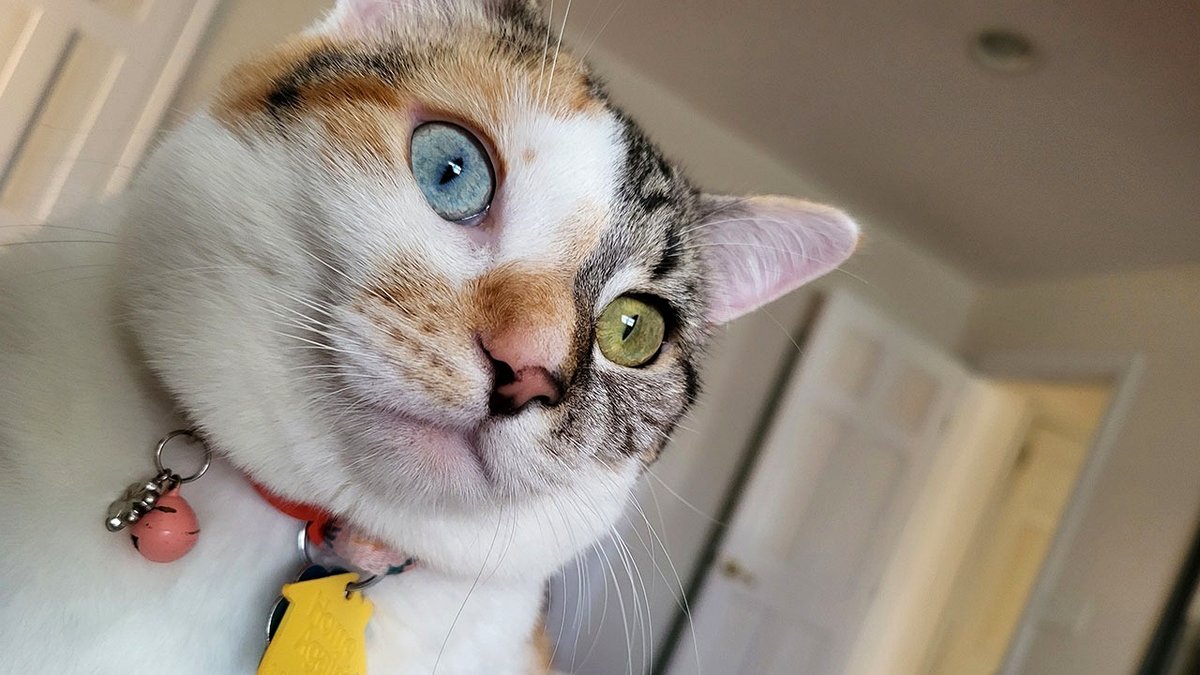
One of Cleo’s standout features is her differently colored eyes, a condition called complete heterochromia. The pattern of her fur is also quite unusual, with a clear division of colors. Her family thinks that Cleo may be a chimera, a genetic condition where an individual has cells from more than one fertilized egg. This can happen when two very early embryos merge during development, leading to an animal with distinct genetic cell types.
However, Cleo’s veterinary records suggest other possibilities too, including blood-cell chimerism and mosaicism, where different genetically distinct cells come from the same fertilized egg. Further tests would be needed to understand the genetic basis of her traits fully.
The unique colors and patterns on her body continue beyond her face. Her owners wonder if some of these features could be linked to another genetic mutation. It’s important to note that simply looking at a cat does not confirm it is a chimera. Research published in Current Biology explains that the orange and black patches found in typical tortoiseshell and calico cats result from a process called X-chromosome inactivation. This process can create different pigmentation areas even in cats that do not have chimerism.
Nonetheless, there have been documented cases of true feline chimerism. A study in 2026 explored an XX/XY chimera’s genetic traits using blood, hair, and saliva samples. The results showed that about 70% of her tested cells carried XX chromosomes, while 30% had XY chromosomes. Cleo’s family believes she is a rare genetic chimera, but more testing would be required to determine the exact nature of her unique genetics. What do you think of Cleo’s unusual features?
Sources:
Source: Bored Panda, by Tarik Velić