A significant art conservation project in China has led to fascinating discoveries thousands of miles away at the Metropolitan Museum of Art in New York City. In the gallery dedicated to Chinese arts and antiquities, a striking 50-foot-long mural captures the spotlight, showcasing the Medicine Buddha alongside his attendants. Zhang Jian, who is the director of the “Meticulous Painting Institute” at the Chinese National Academy of Arts, has long been fascinated by this mural. His organization has been investing billions of RMB since 2013 to restore, conserve, and repatriate Chinese cultural treasures.
Zhang described the mural as having an “awe-inspiring energy” and learned it originally belonged to the Guangsheng Temple in central China. After visiting the temple years later and seeing where the mural once hung, he came up with the idea to create a life-sized replica. Over three years, he and a team of artists and conservators worked at the Met to replicate the mural, paying close attention to every detail, including its cracks and alterations from past restorations. This effort was supported by the Met, marking a significant collaboration between Chinese and American cultural institutions.
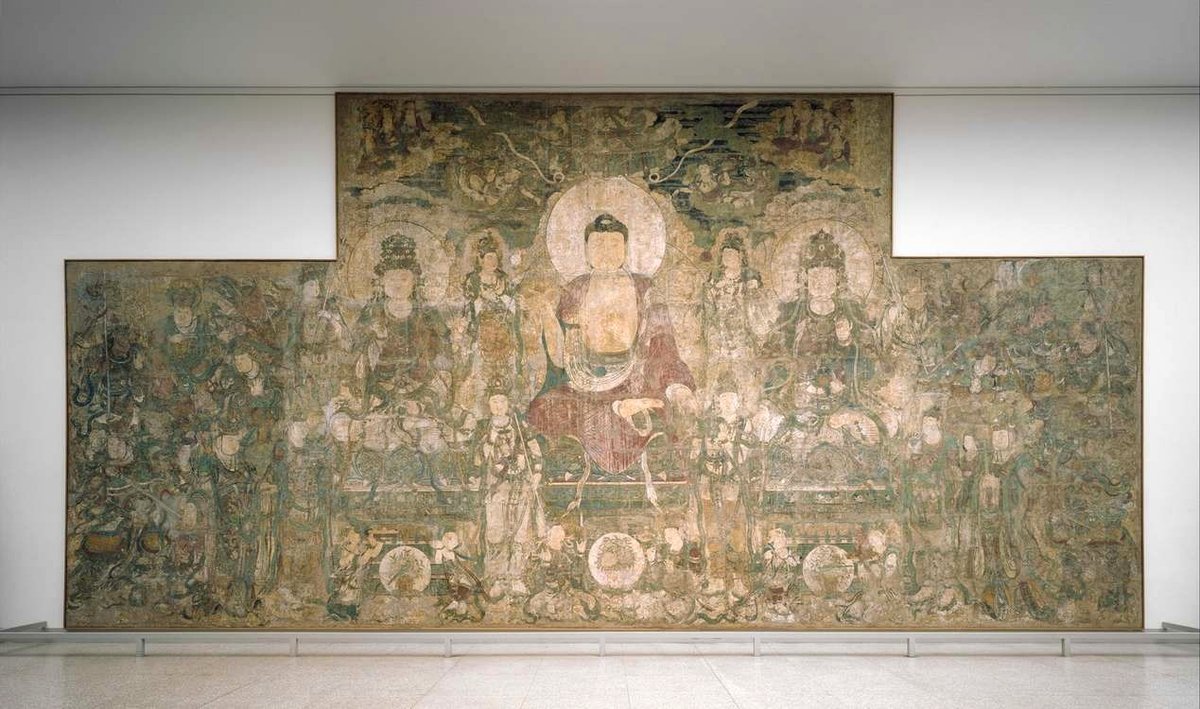
In October, the Met plans to co-host an international symposium in Beijing on Chinese murals, which is the first major academic conference held jointly with a national research organization in China. Jason Sun, the curator of Chinese art at the Met, mentioned to the South China Morning Post that the discoveries made by Zhang’s team, including the realignment of the Buddha’s head, have “profound historical and practical significance.” The mural was painted around 700 years ago during the Yuan Dynasty, using clay tiles mixed with rice straw to depict the Medicine Buddha surrounded by various figures.
The mural’s journey to the Met was not due to colonial exploitation, as mainland China largely escaped Western colonial rule when monks from Guangsheng Temple sold the mural to fund repairs for their temple’s roof. The monks perhaps embraced the idea that all things are impermanent, a key tenet of Buddhism, demonstrating their willingness to let go of the relic. It reached the Met through a donation from Arthur Sackler in 1965.
The China National Arts Fund, established in 2013, focuses on preserving ancient artworks. Recently, this fund undertook the preservation of 40 ancient murals found in Western China. If any of these works are held abroad, the fund is prepared to finance their study and potential recreation. Zhang aimed for a different goal for the recreation, which the Met supported. In 2024, the fund formalized a partnership with the Met, allowing their team access for extensive research and sharing high-resolution images.
Meng Ying, an artist on Zhang’s team, noted that the Met staff helped coordinate visits. The team used specialized equipment to study the work closely, a situation that had not occurred before in the museum’s history. Their methods included creating mud tiles similar to the originals and researching mineral pigments from that era to ensure accuracy.
After thorough examination, the team discovered that the mural’s initial mounting at the Met was misguided, misaligning the Buddha’s head by 2 centimeters. Met staff remarked that once they recognized the error, it was hard to overlook the crookedness. The replica created by Zhang’s team was unveiled at the China National Arts and Crafts Museum in Beijing during a recent exhibition coinciding with President Xi Jinping’s visit to the U.S.
Zhang expressed that this project allows the ancient mural to re-enter modern cultural life while maintaining the context that significant artworks carry through the ages. Other murals from Guangsheng are found in American museums, including locations in Cincinnati and Missouri, with those institutions reaching out to Zhang for assistance in examining their own works.
What do you think about the collaboration between Chinese and American cultural institutions on this project?
Sources:
Source: Good News Network, by Andy Corbley