Frankie Robertson had dedicated many years to helping families cope with premature births. However, she found herself unprepared for the experience of being in a neonatal intensive care unit (NICU) with her own newborn. For nearly a decade, Robertson worked in leadership roles at March of Dimes, an organization focused on preventing premature births. She had heard many parents’ stories, provided support, and shared in the sadness of mothers whose babies were born too early. Yet, going through this experience herself highlighted a significant issue often overlooked in discussions about pregnancy and childbirth: mothers require care and support long after their babies are born.
Philanthropists Olivia and Tom Walton are addressing this important need. In September 2026, they announced a commitment of $100 million over five years to a national initiative called Healthy Moms, Healthy Babies America. This program aims to reduce the nation’s maternal mortality rate by half by 2031. The funding will assist states in expanding effective maternal healthcare approaches, especially in rural and underserved areas where women encounter serious barriers to care. Plans include increasing access to virtual appointments for women far from healthcare providers, training more midwives and community health workers, and enhancing postpartum care during the crucial first year following childbirth.
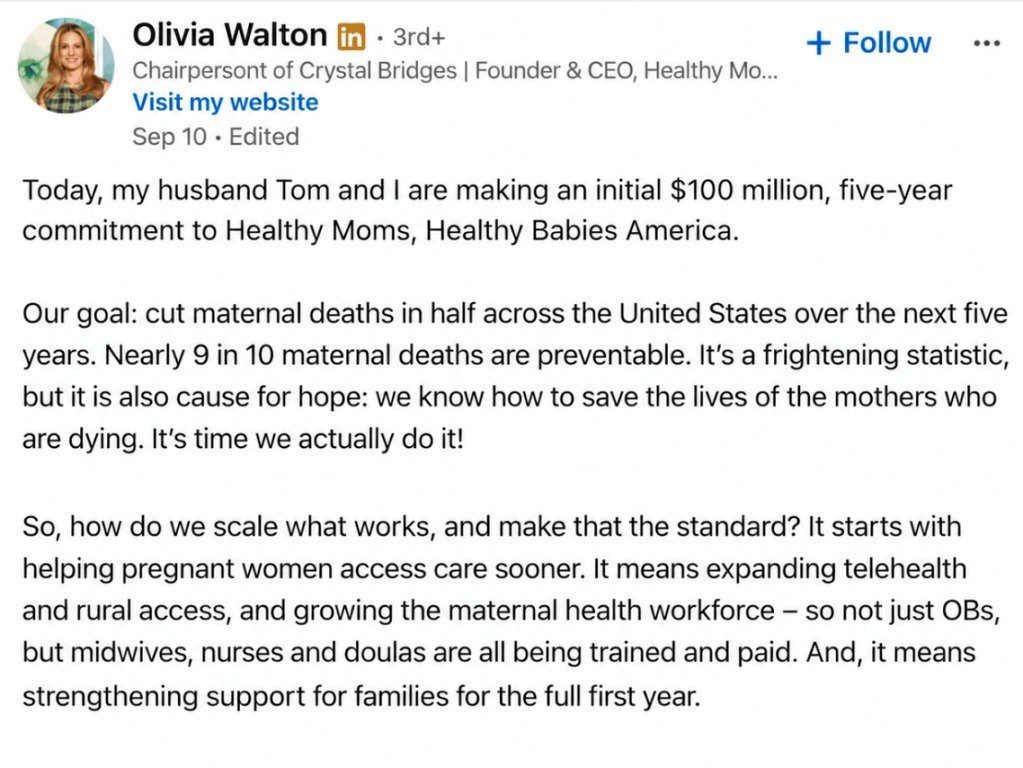
The initiative seeks to implement proven solutions without creating an entirely new healthcare system. The Waltons’ financial support is intended to promote state matching grants, form partnerships, and enhance healthcare infrastructure, with the aim of attracting additional investment to sustain these efforts beyond the initial five years. The clear goal is ambitious yet simple: to cut the maternal mortality rate in half by 2031.
The maternal health risks people face are not the same for everyone. The United States has one of the highest maternal mortality rates among wealthy countries, and these risks are not evenly distributed. In 2024, the Centers for Disease Control and Prevention reported that non-Hispanic Black women were over three times more likely to die from maternal issues than non-Hispanic white women. This disparity stems from systemic inequalities in healthcare, which include unequal access to quality prenatal and postpartum services, increased rates of certain health conditions, and racial bias in medical treatment. Studies indicate that healthcare providers sometimes overlook or inadequately address the concerns of Black women, which can delay critical care.
Geographic location plays a significant role as well. In rural areas, women may need to travel long distances to receive maternity care, making consistent access to prenatal and postpartum support challenging. Robertson, who has worked extensively to promote maternal health equity in Louisiana, believes it is important to consider the backgrounds of women entering pregnancy. This concept, referred to as “weathering,” reflects the cumulative effects of chronic stress, discrimination, and systemic inequalities on health. The hypothesis, first introduced by public health researcher Arline Geronimus, explores how these experiences may lead to poorer health outcomes over time. Robertson noted that it is not just about facing isolated acts of discrimination; the overall emotional and physical toll of constantly managing inequities can have significant impacts.
To improve maternal health, it is essential to look beyond emergencies and recognize the need for ongoing care, emotional support, and access to essential resources before, during, and after childbirth. What might better maternal care look like in practice?
Sources:
Source: Upworthy, by Harmony Hobbs