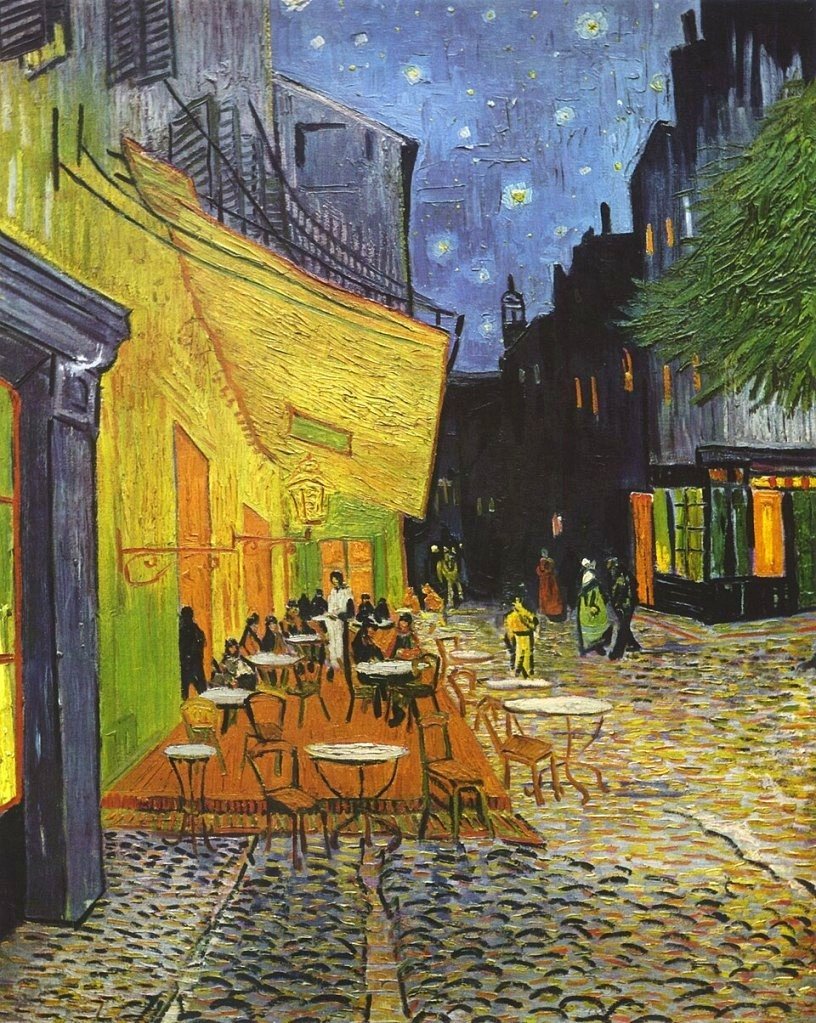
Vincent van Gogh is well-known for his artwork, even though he did not live long enough to witness his own fame. After his death in 1890, many art historians and scholars have studied his works, uncovering more aspects of his unique talent over the years. One of his paintings, “Café Terrace at Night,” took more than a century to be recognized for its subtle connection to a well-known art theme. The painting shows people dining at an outdoor café during the night, showcasing van Gogh’s distinct style and use of colors, notably avoiding black paint.
In looking at the painting, consider the carefully lit area. Count the individuals on the terrace, including the one partially obscured by the server. Observe how the server appears and the shadowy figure leaving the terrace on the left side. Notice the faint cross in the window above the server’s head. It seems that van Gogh may have cleverly included elements of “The Last Supper” in this piece. There are twelve diners, which could represent the twelve disciples, with Jesus serving them, and Judas depicted in shadow as he departs, with the cross positioned behind Jesus.
Van Gogh had a background steeped in Christianity; his father was a pastor, and he trained to be a preacher himself. He worked as a missionary among poor coal miners, earning the title “The Christ of the Coal Mine.” When his contract was not renewed, he turned to painting. Rather than focusing on making overtly religious art like many of his peers, he chose to illustrate the lives of ordinary people he aimed to support. Despite this, art historians have noted religious themes in his work, even in pieces that seem secular. Although van Gogh communicated to his brother, Theo, that he did not plan to create biblical art, symbols from the Bible can still be found in many of his works.
In 2015, independent researcher Jared Baxter proposed the idea that van Gogh included “The Last Supper” in “Café Terrace at Night.” He provided evidence in a two-part series, which some art scholars have supported. Baxter stated that van Gogh painted with a view towards the future, drawing inspiration from past artists without copying them. He believed van Gogh found the sacred in daily life, portraying ordinary people such as laborers and mothers, infusing these scenes with historical artistic influences. The idea suggests that the sacred can be found in everyday moments, even among café patrons at night.
Around the time he created “Café Terrace at Night,” van Gogh expressed to Theo a strong desire for religion. This may have influenced his artistic choices, but there is no clear evidence that van Gogh intended to reference “The Last Supper” in this painting. Baxter mentioned the importance of acknowledging that interpretations of art can vary and that absolute certainty is elusive. He believed there is sufficient evidence to support his theory.
It is intriguing that it took over a century for someone to make this connection. What do you think about the possible inclusion of “The Last Supper” in van Gogh’s work?
Sources:
Source: Upworthy, by Annie Reneau