On September 3rd, the European Space Agency (ESA) announced that its BepiColombo mission successfully reached Mercury, marking the third spacecraft to explore this closest planet to the Sun. Despite being nearer to Earth, getting to Mercury takes over eight years, similar to the journey to Pluto. The Sun’s strong gravitational force makes a direct approach impossible without large propulsion systems that are unsuitable for a mission like BepiColombo. Instead, the spacecraft needed to perform multiple flybys of other planets to use their gravity for assistance. In total, BepiColombo completed nine flybys to safely slow down as it approached Mercury. The spacecraft had to reach Mercury at just the right speed; too fast would mean missing it, while too slow could cause it to veer off course. ESA successfully navigated through 6 billion miles, and the first stage of arrival was completed to the excitement of mission control in Darmstadt, Germany. ESA reported that the Mercury Transfer Module (MTM) had separated successfully from the spacecraft. This significant milestone in the joint mission with the Japan Aerospace Exploration Agency (JAXA) marks the beginning of BepiColombo’s long-awaited examination of Mercury.
The MTM contained a hybrid propulsion system that utilized both solar and gas propellants to navigate through the gravitational forces. After reaching a distance of 1.8 million miles from Mercury, the module’s role was finished and it was released, with ESA considering the operation one of their most complex planetary arrival sequences ever. ESA’s BepiColombo B-shift Spacecraft Operations Manager, Emmanuela Bordoni, described the moment as powerful when they confirmed the MTM had separated.
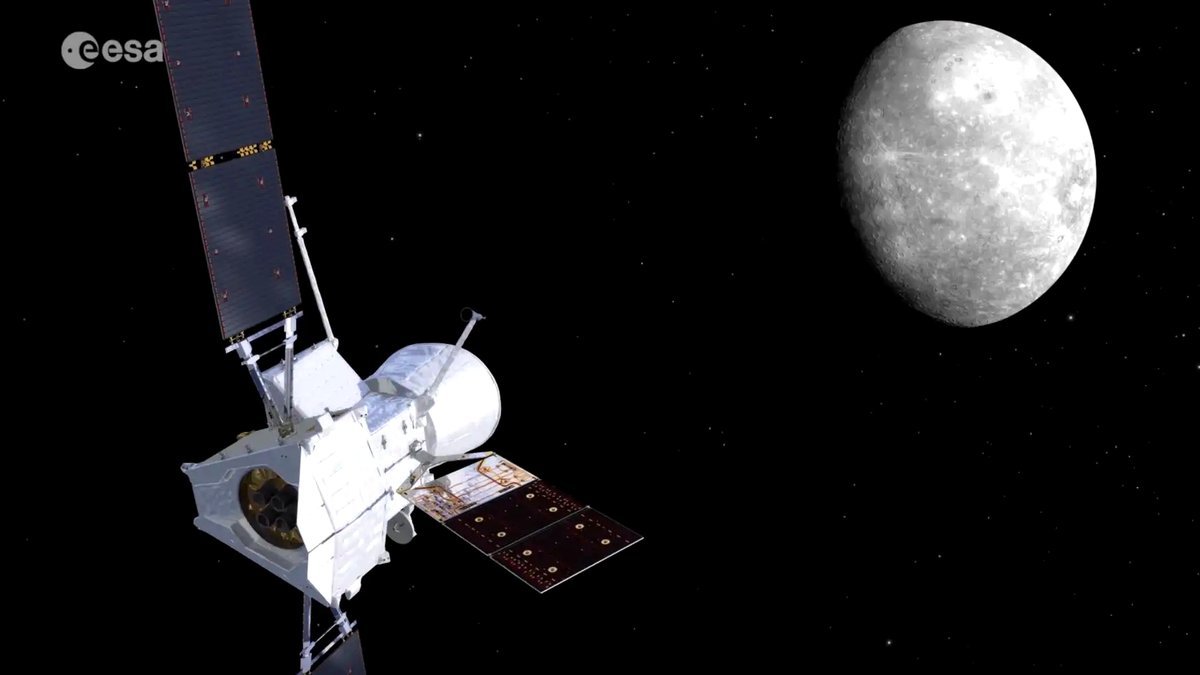
The mission will provide new insights into Mercury’s surface, interior, magnetic field, and environment once the primary science modules begin operations in April 2027. Geraint Jones, ESA’s Lead Project Scientist for BepiColombo, noted that while there have already been significant findings from the cruise phase and the nine flybys, this initial step is vital for using the advanced instruments on both the Mercury Planetary Orbiter (MPO) and Mio.
Even though Venus is often called our closest neighbor, Mercury’s faster orbit allows it to be nearer to Earth for more time each year. Mercury was first visited by NASA’s Mariner 10 mission, which flew by three times in the 1970s, and then by the MESSENGER mission that orbited the planet from 2011 to 2015. Mariner 10 made history with the first gravity assist by using Venus to reach Mercury, taking 2,700 images during its visits. It found that Mercury has a weak magnetic field and measured extremely low nighttime temperatures as well as high daytime temperatures.
The MESSENGER mission provided further insights over its four years in orbit, including findings on Mercury’s surface composition and geological history. It identified features of the planet’s magnetic field and confirmed that its polar deposits contain mostly water ice. MESSENGER also discovered high levels of magnesium and calcium on Mercury’s night side and a significant shift of the planet’s magnetic field from its center.
BepiColombo, named after the Italian mathematician and engineer Giuseppe “Bepi” Colombo, aims to deepen our understanding of Mercury, a planet that remains largely mysterious. The mission seeks to learn how a planet can form near its star, the nature of its interior—like the presence of plate tectonics or volcanic activity—and details about its magnetic fields. BepiColombo may also help explain the origin of unique features on Mercury, such as “lobate scarps,” which are long ridges that can reach heights of 1,500 meters. One theory suggests these scars formed as Mercury cooled after its crust solidified. Another mystery involves Mercury’s unusually high iron core content compared to other planets.
Measurements from previous missions indicated that Mercury’s magnetic field is stable and its strength around the equator is comparable to Earth’s. This field helps protect the planet from solar radiation, even though it is close to the Sun. MESSENGER also found that this magnetic field has “leaks,” which are created by magnetic tornadoes that allow solar wind to reach the surface.
BepiColombo consists of two main modules that will study Mercury. Currently connected, these modules are set to enter a polar orbit around the planet on November 26th, with Mio being separated two weeks before Christmas. Designed by JAXA, Mio will investigate the magnetosphere, while the MPO, equipped with 11 scientific instruments, will finalize its orbit in March. What discoveries will BepiColombo reveal about Mercury’s mysteries?
Sources:
Source: Good News Network, by Good News Network