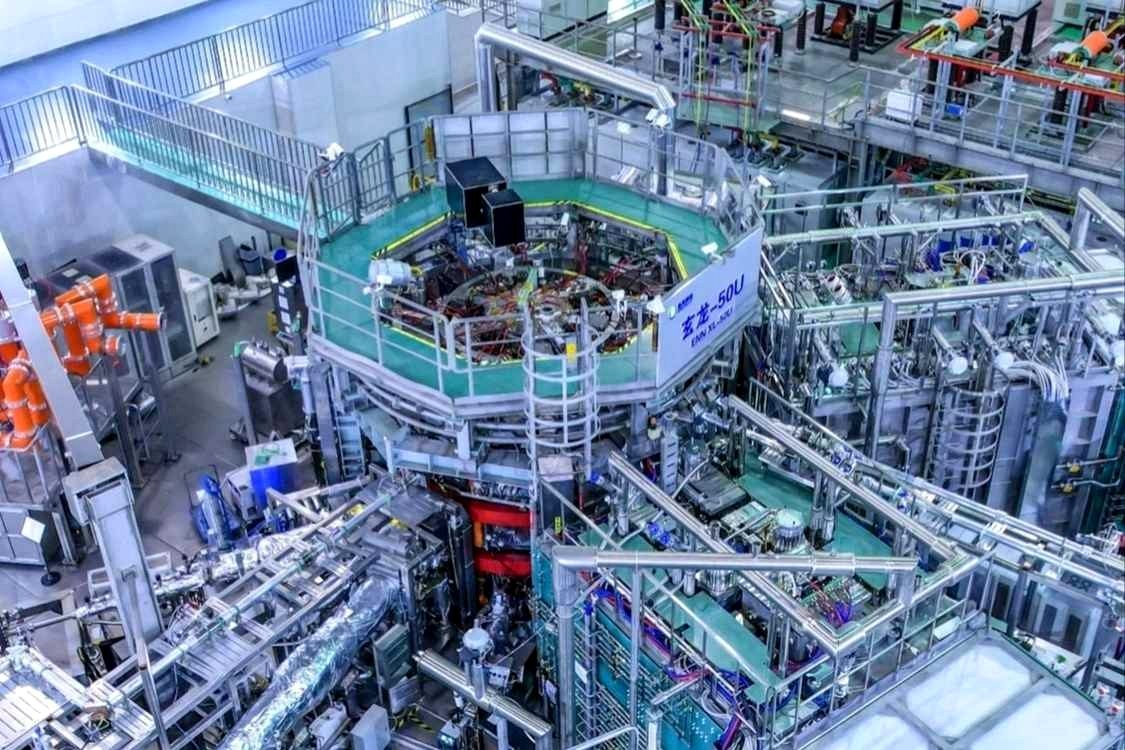
Chinese engineers have made a significant advancement by achieving brief nuclear fusion using a cleaner and more abundant fuel. An international review team has called this progress “significant and valuable.” A state-backed energy company utilized hydrogen-boron as fuel and employed a laser and radio waves to create plasma within a spherical reactor device known as a tokamak.
Nuclear fusion aims to replicate the energy-producing process of the Sun, where two atomic nuclei combine, releasing substantial energy. This process has the potential to generate enough energy for a household for a lifetime from just one glass of seawater. It produces no emissions and avoids the radioactive waste associated with current nuclear fission power.
However, there are challenges in pursuing fusion energy. The standard fuel mixture of deuterium and tritium, which is often considered necessary for commercial fusion, produces radiation and is expensive. While deuterium can be extracted from seawater, tritium is naturally radioactive and found only in trace amounts.
In contrast, ENN Group, a leading clean energy provider in China, has opted for hydrogen-boron. Their method involves fusing a hydrogen proton with a boron-11 nucleus to produce harmless helium nuclei and energy without emitting high-energy neutrons. Some private fusion companies, like TAE Technologies in the US and Marvel Fusion in Germany, are also exploring hydrogen-boron as a fuel source.
Yang Yuanming, the chief engineer of the ENN project, explained that their method for generating plasma is innovative. Instead of relying solely on heating the reactor’s molecules to high temperatures using magnetic fields, ENN combined high-energy neutral beam injection with radio frequency waves to effectively target the reaction site in the hydrogen-boron fuel. This approach generates a large number of fast protons that act as a catalyst for the reaction, significantly increasing the fusion reaction rate.
A group of visiting scientists reviewed the experiment and agreed it was a valuable contribution to the field, likely influencing future efforts in commercializing nuclear fusion. Yang shared this achievement on social media and expressed a goal of reaching a plasma temperature of 100 million degrees Celsius as soon as possible.
Sources:
Source: Good News Network, by Andy Corbley